The snow has cleared and I am gradually getting a better grip on the new computer. The transcribing progress on St Patrick's Ward has picked up. Not only have I been able to get to the FHC for the last three sessions, but Ancestry has finally made the ward available on their website. Some of the folios are so pale that it takes both their transcription and mine to make any sense out of what was originally written down.
I am now working on District 3, a huge area which starts at Spadina and progresses west. I haven't seen Hope Street (which turned into Manning Avenue), so either it is in District 4 or in the 150 folios of District 3 that I have yet to see. On the south-north axis, all the districts started at Queen Street West and stretched all the way up to Bloor, but there weren't many people living north of College Street.
While transcribing the other day I came across a civil engineer named William Armstrong. He had a wife and 7 children and 3 boarders. He lived on Queen Street and he had named his house Toronto Priory. I had come across the name of the house before in Caverhill's Directory, along with his business address at 46 King Street East. At that point bells began to ring. One of Mr Armstrong's boarders was D Beere, another civil engineer. Armstrong, Beere & Hime were the photographers who took the series of photographs from the roof of Rossin House (later the Prince George Hotel) in 1856.
The facts coming together from the census and both city directories (Mitchell placed Toronto Priory between Vanauley and Esther Streets) weren't enough for me. I had to find another reference to William Armstrong. Sadly, the Dictionary of Canadian Biography did not see fit to mention him, nor did Eric Arthur's book, Toronto, No Mean City. Time to do a search in Google where I found Greater Toronto Archives to have a special section on the firm at www.toronto.ca/archives/earliest_4_whowere.htm . I am still not clear about Armstrong and Beere's contributions to civil engineering, but their contribution to memorializing 19th century Toronto through photography was truly worthwhile.
Monday, 25 January 2010

Wednesday, 13 January 2010
A New Year with Changes
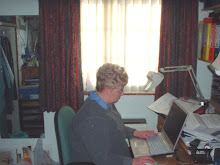
I just caught a glance at my signature photo as I came to write this note.
The desk is the same, the sweater was the one I was wearing yesterday, but the lamp is gone and, the really big thing, the computer is different. For Christmas my son gave me a new huge machine which he put together himself. Two disk drives, two DVD drives, Windows 7, and masses of memory into which I can put the whole of the Toronto census and all the links to other information about the people I find there. The only thing it didn't come equipped with was more human brain empowerment to figure out how to move all my data and photographs from the old machine. Gradually I am figuring things out. Yesterday I managed to install the two extra buttons on my mouse, the ones titled "copy" and "paste" which are a vast improvement on ctrl+c and ctrl+v. The mouse is long out of date and finding the driver online took an age. Today the printer must get installed. . . .
You may have heard that the UK has been swaddled in snow. We didn't have a white Christmas (i.e., it didn't snow on Christmas Day), but we did have two big snowfalls in the week before and more since the New Year. It is snowing as I write and two lads off school because of it have just knocked on our door offering to clear our drive. They were armed with homemade snow shovels--not the garden spades that most of us use. The past week has also been very cold and only main roads are clear to drive on.
The transcribing of St Patrick's Ward has been limited by the weather. We have lost three sessions at LDS so far and the one tomorrow will probably be cancelled too. I hear a thaw is on the way for which I am thankful. With the cold weather outside and the powerful fans of the new computer blowing cold air through the keyhole of my desk, I have had to wrap my legs in a duvet.
The 1861 census was taken on the night of 13th January 1861, 149 years ago tonight. There were people living on the wharves at the bottom of St Lawrence Ward! I hope they managed to get a good fire going without burning their shanties down.
The desk is the same, the sweater was the one I was wearing yesterday, but the lamp is gone and, the really big thing, the computer is different. For Christmas my son gave me a new huge machine which he put together himself. Two disk drives, two DVD drives, Windows 7, and masses of memory into which I can put the whole of the Toronto census and all the links to other information about the people I find there. The only thing it didn't come equipped with was more human brain empowerment to figure out how to move all my data and photographs from the old machine. Gradually I am figuring things out. Yesterday I managed to install the two extra buttons on my mouse, the ones titled "copy" and "paste" which are a vast improvement on ctrl+c and ctrl+v. The mouse is long out of date and finding the driver online took an age. Today the printer must get installed. . . .
You may have heard that the UK has been swaddled in snow. We didn't have a white Christmas (i.e., it didn't snow on Christmas Day), but we did have two big snowfalls in the week before and more since the New Year. It is snowing as I write and two lads off school because of it have just knocked on our door offering to clear our drive. They were armed with homemade snow shovels--not the garden spades that most of us use. The past week has also been very cold and only main roads are clear to drive on.
The transcribing of St Patrick's Ward has been limited by the weather. We have lost three sessions at LDS so far and the one tomorrow will probably be cancelled too. I hear a thaw is on the way for which I am thankful. With the cold weather outside and the powerful fans of the new computer blowing cold air through the keyhole of my desk, I have had to wrap my legs in a duvet.
The 1861 census was taken on the night of 13th January 1861, 149 years ago tonight. There were people living on the wharves at the bottom of St Lawrence Ward! I hope they managed to get a good fire going without burning their shanties down.
Thursday, 24 December 2009
MC--HNY
The pudding is made, the stuffing is ready to put in the turkey, the presents are all wrapped, and I haven't done any census transcription since Monday. It's time to say
too.
MERRY CHRISTMAS
to everyone and a
HAPPY NEW YEAR
too.
Sunday, 13 December 2009
I can't read that
 Invisible
 Unreadable
As transcription goes on I have decided that the word "illegible" can often cover too wide a variety of problems. For this reason I find myself using one of four different words, each of which will describe the specific situation more distinctly.
Unreadable. This usually relates to the quality of the writing or the writing instrument or the paper which has made it impossible for the microfilming camera to pick up a smooth image. A copperplate nib might be responsible, so might ink thickened through lack of use, or paper exposed to damp before or after it has been written on.
Invisible. This infers that the writing is so pale that it is impossible to see anything at all. Occasionally one can pick up a given name or initial. This most often occurs in the Names and Occupation columns. Often the ages and sexes are visible, so that the transcriber can tell how many people will be missed and whether it was a straightforward family or a boarding house. These entries were probably made in pencil, although some are so bad that I wonder if a dirty nail was used instead. Did the enumerators of St John's and St Patrick's have an arrangement that they would rub out families' names if they were slipped 50 cents or a dollar? Many other families have had their entries crossed out and rewritten when there appears to be nothing wrong with the original.
Unrecognizable. This usually refers to birthplaces, particularly where the householder has written a specific place in Ireland, England or Scotland which I just can't make out. If he has messed up the initial letter there is no point in staring at a gazetteer to solve the problem.
Queried. I use this when I have made an attempt at reading a name but am not sure I am right. The word is scattered liberally over my transcription. Anyone is welcome to have another go.
Unreadable. This usually relates to the quality of the writing or the writing instrument or the paper which has made it impossible for the microfilming camera to pick up a smooth image. A copperplate nib might be responsible, so might ink thickened through lack of use, or paper exposed to damp before or after it has been written on.
Invisible. This infers that the writing is so pale that it is impossible to see anything at all. Occasionally one can pick up a given name or initial. This most often occurs in the Names and Occupation columns. Often the ages and sexes are visible, so that the transcriber can tell how many people will be missed and whether it was a straightforward family or a boarding house. These entries were probably made in pencil, although some are so bad that I wonder if a dirty nail was used instead. Did the enumerators of St John's and St Patrick's have an arrangement that they would rub out families' names if they were slipped 50 cents or a dollar? Many other families have had their entries crossed out and rewritten when there appears to be nothing wrong with the original.
Unrecognizable. This usually refers to birthplaces, particularly where the householder has written a specific place in Ireland, England or Scotland which I just can't make out. If he has messed up the initial letter there is no point in staring at a gazetteer to solve the problem.
Queried. I use this when I have made an attempt at reading a name but am not sure I am right. The word is scattered liberally over my transcription. Anyone is welcome to have another go.
Thursday, 10 December 2009
Planning Ahead
This afternoon, after raising my count of households photographed in St Patrick's to 130, I decided to inspect the two films borrowed from the LDS to see just what was covered by both of them.
The first film continues through St Patrick's for 979 folios or households. The last district is number four which has barely started at the end of the first film and continues on into the second film for a total of 164 folios. The whole ward comprises 1101 households.
The rest of the relatively small second film contains the various institutions in and around Toronto which had their own populations. These are not listed in households but on pages of 50 inhabitants, rather like the rural township census forms.
I have always been curious as to the actual institutions which formed this group. Here they are, together with the number of pages it took to list their "inmates". The inmates included everyone on the premises, even those in charge of the institution.
Trinity College, Queen Street West, St Patrick's Ward
Toronto University buildings, Queen's Park, St Patrick's Ward
Knox College, Grosvenor Street, St John's Ward
St Michael's College, St Joseph's Street, St John's Ward
House of Providence, Power Street, St David's Ward
House of Industry, Edward Street, St John's Ward
Orphan's Home, St Patrick's Ward
Boys' Home, King Street East, St James's Ward (The Girls' Home was listed in with St James's Ward itself.)
St Mary's Convent, St Joseph's Street, St John's Ward
The Peninsula or The Island, St George's Ward
Provincial Lunatic Asylum, part one, St Andrew's Ward
Provincial Lunatic Asylum, part two, St Andrew's Ward
Toronto General Hospital, St David's Ward
Toronto Jail
Toronto Garrison, St George's Ward
Old Fort York, St George's Ward
So, "The Pensinsula" was an "institution". Who would have thought it? It is a part of Toronto rather dear to my heart as I would have been included on its 1941 census, had that census happened. In 1861 the inhabitants included David Ward and his large family, members of the Hanlan family, and a few others.
A learning institution I was expecting to find but didn't was Upper Canada College. Some pupils were boarding with masters on the grounds in St George's Ward proper, but there were no dormitories such as those ususally described in 19th century private schools. I can only presume that the term had not started on January 14th and most pupils were still at home.
I was surprised that it took 10 pages to cover the Toronto Garrison. Admittedly this included all the families in married quarters, but that was still a lot of British soldiers stationed 3000 miles from home in what was to all extents peacetime (save for internal problems across the American border, of course).
I should finish St Patrick's District One next week, and there is still one more session available in the library before Christmas. I think I will work on some of the institutions that day rather than leave them all to the end.
The first film continues through St Patrick's for 979 folios or households. The last district is number four which has barely started at the end of the first film and continues on into the second film for a total of 164 folios. The whole ward comprises 1101 households.
The rest of the relatively small second film contains the various institutions in and around Toronto which had their own populations. These are not listed in households but on pages of 50 inhabitants, rather like the rural township census forms.
I have always been curious as to the actual institutions which formed this group. Here they are, together with the number of pages it took to list their "inmates". The inmates included everyone on the premises, even those in charge of the institution.
Trinity College, Queen Street West, St Patrick's Ward
Toronto University buildings, Queen's Park, St Patrick's Ward
Knox College, Grosvenor Street, St John's Ward
St Michael's College, St Joseph's Street, St John's Ward
House of Providence, Power Street, St David's Ward
House of Industry, Edward Street, St John's Ward
Orphan's Home, St Patrick's Ward
Boys' Home, King Street East, St James's Ward (The Girls' Home was listed in with St James's Ward itself.)
St Mary's Convent, St Joseph's Street, St John's Ward
The Peninsula or The Island, St George's Ward
Provincial Lunatic Asylum, part one, St Andrew's Ward
Provincial Lunatic Asylum, part two, St Andrew's Ward
Toronto General Hospital, St David's Ward
Toronto Jail
Toronto Garrison, St George's Ward
Old Fort York, St George's Ward
So, "The Pensinsula" was an "institution". Who would have thought it? It is a part of Toronto rather dear to my heart as I would have been included on its 1941 census, had that census happened. In 1861 the inhabitants included David Ward and his large family, members of the Hanlan family, and a few others.
A learning institution I was expecting to find but didn't was Upper Canada College. Some pupils were boarding with masters on the grounds in St George's Ward proper, but there were no dormitories such as those ususally described in 19th century private schools. I can only presume that the term had not started on January 14th and most pupils were still at home.
I was surprised that it took 10 pages to cover the Toronto Garrison. Admittedly this included all the families in married quarters, but that was still a lot of British soldiers stationed 3000 miles from home in what was to all extents peacetime (save for internal problems across the American border, of course).
I should finish St Patrick's District One next week, and there is still one more session available in the library before Christmas. I think I will work on some of the institutions that day rather than leave them all to the end.
St Patrick's Ward gets started
St Patrick's Ward started out just where I expected--at the northwest corner of Queen Street West and University with an enumeration district of 261 houses. The enumerator made his way along the north side of Queen for about three blocks and then proceeded to work on the side streets. At least, this is what appeared from what I saw on Tuesday and checked later with the streets directory section of Mitchell's City Directory of 1864.
I usually try to photograph 75 folios or households a day, but on Tuesday I had forgotten one of my preparational steps. Thus, my camera told me its memory card was full as I reached house 57. Today I have made sure my camera is empty to start with, but I must look out my second 2GB memory card.
The families were quite a mixture, with occupations stretching from labourer up to "gentlemen" and merchants, with a fair sprinkling of men and widowed women who did not see fit to tell the census authorities what, if anything, they did to keep the wolf from the door. There were at least two people who lived alone, and some very large families (one of seventeen members including a few servants). Three households were impossible to read--a high score for one day's work. The unusual thing was the number of deaths in 1860 recorded. The enumerator must have been especially vigilant on this score. I have found census districts which did not include any at all and I am sure Toronto was not that healthy at the time.
The proofreading of St John's District 3 was completed before starting on St Patrick's and with luck I can finish the small District 6 north of College over the weekend. District 6 was so different from the rest of the ward. Suburbia I guess you would call it. Yonge Street was commercial and included Thomas Christie's first biscuit factory and a large builder's with a lot of men recorded there. The surnames in the builder's yard were familiar. The employer may simply have listed all his workmen or the employees may have stayed there over a Sunday night prior to going to a nearby job on the Monday morning. University College was completing construction at the time and there were at least four painters in that list. Back of Yonge Street were clerks, bookkeepers, merchants and barristers and the one titled person I have found in the whole of Toronto: Lady Macauley. Her late husband had been a judge and had died in 1859. Knox College was in the middle of this ward and St Michael's on the edge of it. Most of their "inmates" will probably be found in the Institutions file I have yet to get to on the second film of St Patrick's Ward.
I usually try to photograph 75 folios or households a day, but on Tuesday I had forgotten one of my preparational steps. Thus, my camera told me its memory card was full as I reached house 57. Today I have made sure my camera is empty to start with, but I must look out my second 2GB memory card.
The families were quite a mixture, with occupations stretching from labourer up to "gentlemen" and merchants, with a fair sprinkling of men and widowed women who did not see fit to tell the census authorities what, if anything, they did to keep the wolf from the door. There were at least two people who lived alone, and some very large families (one of seventeen members including a few servants). Three households were impossible to read--a high score for one day's work. The unusual thing was the number of deaths in 1860 recorded. The enumerator must have been especially vigilant on this score. I have found census districts which did not include any at all and I am sure Toronto was not that healthy at the time.
The proofreading of St John's District 3 was completed before starting on St Patrick's and with luck I can finish the small District 6 north of College over the weekend. District 6 was so different from the rest of the ward. Suburbia I guess you would call it. Yonge Street was commercial and included Thomas Christie's first biscuit factory and a large builder's with a lot of men recorded there. The surnames in the builder's yard were familiar. The employer may simply have listed all his workmen or the employees may have stayed there over a Sunday night prior to going to a nearby job on the Monday morning. University College was completing construction at the time and there were at least four painters in that list. Back of Yonge Street were clerks, bookkeepers, merchants and barristers and the one titled person I have found in the whole of Toronto: Lady Macauley. Her late husband had been a judge and had died in 1859. Knox College was in the middle of this ward and St Michael's on the edge of it. Most of their "inmates" will probably be found in the Institutions file I have yet to get to on the second film of St Patrick's Ward.
Friday, 4 December 2009
St Patrick's Ward Transcription starts Tuesday
The other day I received word that our local Family History Centre is back open for business following a three-month break while the Latter Day Saints chapel had a renovation. Come Tuesday I can go back to the process of adding new people to the 1861 census database.
St Patrick's is the last ward to do. I know it includes the area north of Queen Street West and west of what is now University Avenue. The northern boundary is present-day Bloor Street West and it will stretch west to . . . . well, that is something I shall have to find out. From the looks of the map of the ward in 1861, there was a sizeable population in the rectangle bounded by Queen, College, University and Bathurst. There were also people living west of that along the Queen Street corridor, but not that many further north.
Population density in St Patrick's is going to be governed by the availability of transporation. People would either have to work close to home, perhaps running their own businesses, or be able to travel daily into the more built-up parts of the city. In 1861 in Toronto public transportation was just beginning to come into existence. Travelling to the centre by carriage was for the much better off, travelling in on horseback would involve more problems than just those we have today parking a car.
I look forward to charging up my camera on Monday night ready for my first three-hour stint on Tuesday.
Meanwhile, I have been proofreading St John's Ward. Districts One and Two are complete and back into the big database. Now I am tackling District Three--308 households containing 1500 people--in the area from Queen north to Agnes Street (now Dundas) and from Yonge over to Terauley (now Bay Street). More than half of this is now covered by the Eaton Centre. The enumerator started with Agnes, then did the north and south streets and finally tackled the east-west ones starting at Queen and progressing northward. I just finished Albert Street. Now there is Trinity Square, Louisa and Alice--92 houses. With a bit of luck I shall get that done and, perhaps, District 6 north of College before I start on St Patrick's.
St Patrick's is the last ward to do. I know it includes the area north of Queen Street West and west of what is now University Avenue. The northern boundary is present-day Bloor Street West and it will stretch west to . . . . well, that is something I shall have to find out. From the looks of the map of the ward in 1861, there was a sizeable population in the rectangle bounded by Queen, College, University and Bathurst. There were also people living west of that along the Queen Street corridor, but not that many further north.
Population density in St Patrick's is going to be governed by the availability of transporation. People would either have to work close to home, perhaps running their own businesses, or be able to travel daily into the more built-up parts of the city. In 1861 in Toronto public transportation was just beginning to come into existence. Travelling to the centre by carriage was for the much better off, travelling in on horseback would involve more problems than just those we have today parking a car.
I look forward to charging up my camera on Monday night ready for my first three-hour stint on Tuesday.
Meanwhile, I have been proofreading St John's Ward. Districts One and Two are complete and back into the big database. Now I am tackling District Three--308 households containing 1500 people--in the area from Queen north to Agnes Street (now Dundas) and from Yonge over to Terauley (now Bay Street). More than half of this is now covered by the Eaton Centre. The enumerator started with Agnes, then did the north and south streets and finally tackled the east-west ones starting at Queen and progressing northward. I just finished Albert Street. Now there is Trinity Square, Louisa and Alice--92 houses. With a bit of luck I shall get that done and, perhaps, District 6 north of College before I start on St Patrick's.
Subscribe to:
Posts (Atom)

 Posts
Posts

